A loop over n elements a vector at a time, final partial vector included, shaped so that Helium compilers turn it into a low-overhead tail-predicated loop. More...
#include <algorithm>#include <array>#include <cstddef>#include <type_traits>#include "argon/argon_full.hpp"#include "argon/store.hpp"#include "argon/vectorize/first_n.hpp"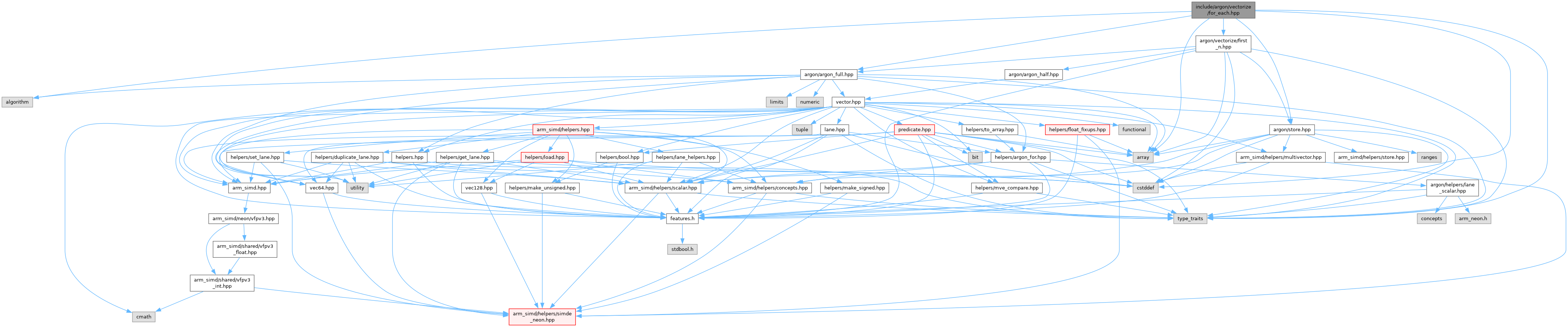
Go to the source code of this file.
Classes | |
| class | argon::vectorize::Step< ScalarType, full > |
| One step of vectorize::for_each: the elements [index(), index() + count()) of the range. More... | |
| class | argon::vectorize::InterleavedStep< ScalarType, Stride, full > |
| One step of vectorize::for_each_interleaved: the frames [index(), index() + count()), each of Stride interleaved elements (a stereo pair, an RGB pixel), loaded as one vector per channel. More... | |
Namespaces | |
| namespace | argon |
| A 128-bit SIMD vector wrapping a scalar type, providing arithmetic, logical, and data-movement operations. | |
Functions | |
| template<typename ScalarType, typename Body> | |
| void | argon::vectorize::for_each (std::ptrdiff_t n, Body &&body) |
| Call body with a Step for each vector's worth of the elements [0, n), the final partial vector included. | |
| template<typename ScalarType, size_t Stride, typename Body> | |
| void | argon::vectorize::for_each_interleaved (std::ptrdiff_t frames, Body &&body) |
| Call body with an InterleavedStep for each vector's worth of the frames frames of Stride interleaved elements, the final partial group included. | |
Detailed Description
A loop over n elements a vector at a time, final partial vector included, shaped so that Helium compilers turn it into a low-overhead tail-predicated loop.
Function Documentation
◆ for_each()
|
inline |
Call body with a Step for each vector's worth of the elements [0, n), the final partial vector included.
- Template Parameters
-
ScalarType The lane type of the loop.
- Parameters
-
n The number of elements. body A callable taking a Step by value, generic in it ([&](auto step) { ... }): on NEON it is called with full steps and then once with a partial one.
On Helium, GCC and clang compile this into a low-overhead tail-predicated loop (dlstp/letp), with no scalar epilogue: the loop is a signed counter, a vctp of the remaining count, and predicated accesses, the shape they recognise. (GCC does so for float loops only with -fno-trapping-math, since the inactive lanes compute too.) On NEON the whole vectors use plain loads and stores, and the last step loads and stores only its in-range lanes, branching on their count: active() is built only if the body asks for it.
◆ for_each_interleaved()
|
inline |
Call body with an InterleavedStep for each vector's worth of the frames frames of Stride interleaved elements, the final partial group included.
- Template Parameters
-
ScalarType The element type. Stride 2, 3 or 4 elements per frame.
- Parameters
-
body A callable taking an InterleavedStep by value, generic in it ([&](auto step) { ... }).
Whole groups use vld2-vld4 / vst2-vst4 in a low-overhead loop. The structured loads can't be predicated, so on NEON the last, partial group moves only its in-range frames with them, and on MVE it gathers and scatters each channel under a predicate (a dls/le loop rather than dlstp/letp). On MVE, which has no vld3, stride 3 gathers every group under a predicate instead, which can become a tail-predicated dlstp/letp loop. If every channel gets the same treatment, for_each over the interleaved data as flat elements is simpler and faster.